About
Mining is the mission.
Human rights in critical-minerals supply chains have been discussed for decades and too often left unresolved.
The choice between industrial mining and artisanal livelihoods has usually been framed as either-or. We have built a model that carries artisanal mining through to full industrial operation: more jobs, safer workplaces, stronger governance and traceability, and careful stewardship of both the resource and the environment.
Guided by the Christian principle of good stewardship, our mission is community transformation, prosperity at the source, and shareholder returns we can defend on moral as well as financial grounds.
Our values
Three values have guided Power Elements since its founding.
Protect and improve human rights. We protect the rights of everyone our work touches, from the people at our sites to those along our supply chain, and we judge ourselves by whether their lives are safer, fairer and more secure because we are there.
Create fair value and transparent supply chains. We create value at the source, by mining and refining material in the region it comes from, and we make every step of its journey from mine to customer visible and verifiable.
Work towards zero waste. We design our mining and refining so that what one process leaves behind becomes feedstock for another, and we work to close every loop the chemistry allows.
Our Code of Conduct turns these values into rules for every director, employee and contractor, and the Board oversees how they are kept. Anyone, inside or outside the company, can raise a concern in confidence through our Speak up channel, without fear of retaliation.
Our origin
2012: a better way to recover minerals. Ray Power set out to develop mineral processing technologies that could rehabilitate old tailings sites, combining new methods for recovering fine-grained minerals with proprietary chemistry to extract value from material the industry had written off. One of those fine-grained recovery methods later grew into a partnership, and then into a company of its own: Gravity Mining, in which the group has maintained a stake since. Dr Matevž Pavlič was researching mine modelling with neural networks, an early form of what is now mainstream artificial intelligence. Each saw the same technology-driven future for mining from a different side.
The problem. For decades, tantalum supply had been tied to conflict, child labour, forced labour and unsafe mining. The deposits that carry it are pegmatites: fine-grained and complex, holding tin, tungsten, lithium, hafnium, zirconium and other elements now classed as critical. They are usually too small for the major miners and too complex for the juniors, so they were left to hand labour and informal traders, and the 3Ts (tin, tantalum and tungsten) went largely without industrial investment.
The idea. Conventional mining needs large, high-grade deposits to pay for the organisation that runs them. The founders set out to change the organisation, so that good deposits would no longer be ruled out by the cost of traditional management. With AI-driven mine modelling, faster process engineering, in-house mechano-chemical processing and a small leadership team supported by automated management systems, a smaller, lower-grade deposit could earn strong returns, and the people already mining it by hand could become the skilled, mechanised workforce that runs it.
2015 to 2020: proving it. The partnership was formalised in 2015 as part of a wider roll-up, and feasibility work on mining and refining began in Rwanda and Europe. Over the next five years it extended into metallisation and alloying. In 2020, in the middle of the pandemic, Ray Power and Matevž Pavlič bought out the business.
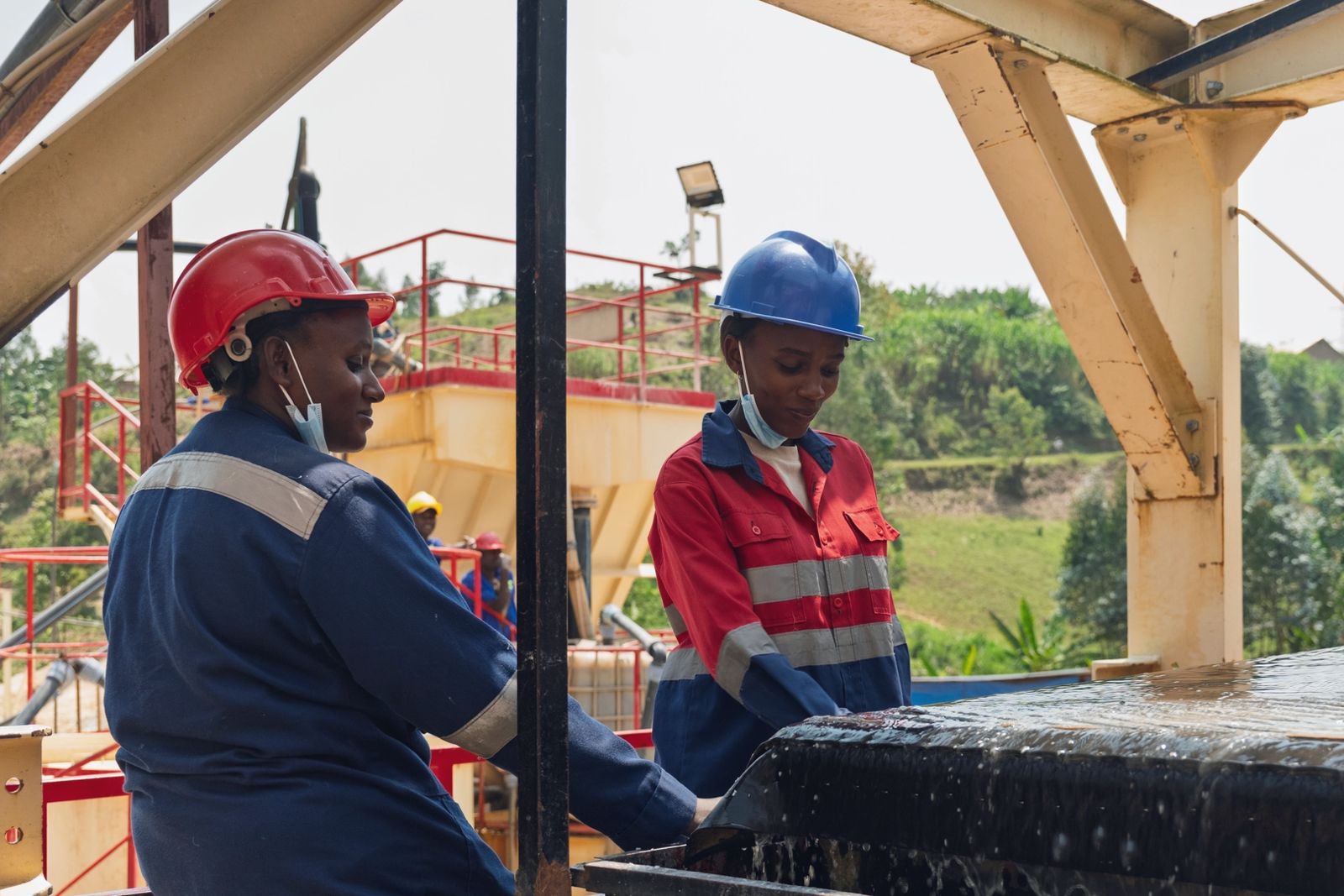
2021 onwards: building it. In 2021 construction began on what became the region's largest industrial tantalum mine, at Rukaragata, and Africa's first RMAP-conformant tantalum–niobium refinery, in the Bugesera Special Economic Zone, both in Rwanda. Bringing both into production showed that technology can carry artisanal mining through to industrial operation on a commercial footing: more jobs, not fewer, and skilled, safer, better-paid work in place of manual, hazardous labour.
Built for the AI era. Power Elements was designed around data from its first day, so it has never had to fit AI into an organisation built without it. A lean leadership team and an AI operating layer do the work that layers of middle management do elsewhere, keeping cash costs down while front-line jobs stay skilled and well paid. By owning every step from the deposit to the refined product, we control the supply we offer, with records to prove it. A decade of data from our mine models, process design and traceability records is the foundation for taking the same approach to partners in the region and to more deposits, more elements and more countries, including deposits the traditional industry passed over because its own costs were too high.
2026: a US company. As part of our AI-led critical-minerals growth strategy, we have moved from Power Resources International Ltd in the United Kingdom to become Power Elements, Inc. in Texas.
Texas, with its energy, engineering, and technology economy, is a natural home for a company built on data and automation, bringing a world-class supply chain directly to the market that needs it.
Looking ahead. Around our mines, we intend to help local businesses start and grow, creating work beyond our own operations, and to support education centres and help tackle malnutrition. In our refining operations, we will keep pursuing lower production costs, higher recovery rates and a wider range of products.
The full list of group companies, where each is registered and who owns it, is on the Structure page.
Next